The idea
Metric Units questions combine accurate calculation with careful use of units.
Follow these steps
- Read every unit before calculating.
- Convert all values to the same unit.
- Complete the operation, then give the answer in the unit requested.
See the method in action
Example 1
What is the difference, in g, between 2 kg and 2,250 g?
Conversion bridge
- 2 kg = 2,000 g.
- The difference is 2,250 − 2,000 = 250 g.
Example 2
A café needs 11 litres of juice. There is 9 litres and 125 ml available. How much more is needed, in ml?
11 litres target9 litres 125 ml
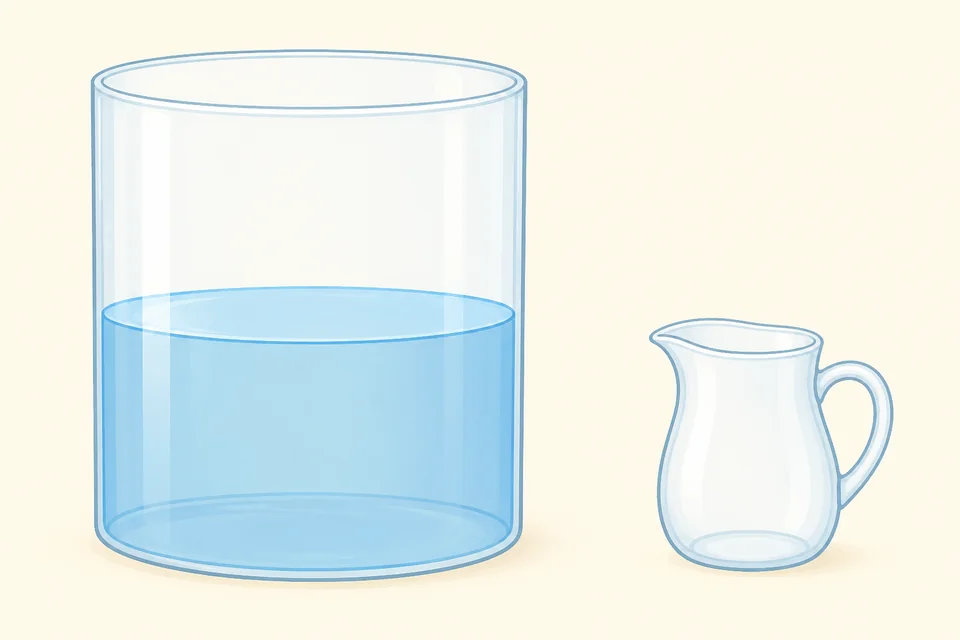
- First convert both quantities to ml: the target is 11,000 and the current quantity is 9,125.
- Then subtract 9,125 from 11,000 to get 1,875 ml.
A useful shortcut
Convert first, calculate second.
Watch out for these
Using the wrong conversion factor
Use 1,000 between kg and g, litres and ml, and km and m; use 100 between m and cm.
Three fresh questions
Ready to check the method? You will get three fresh, validated questions.